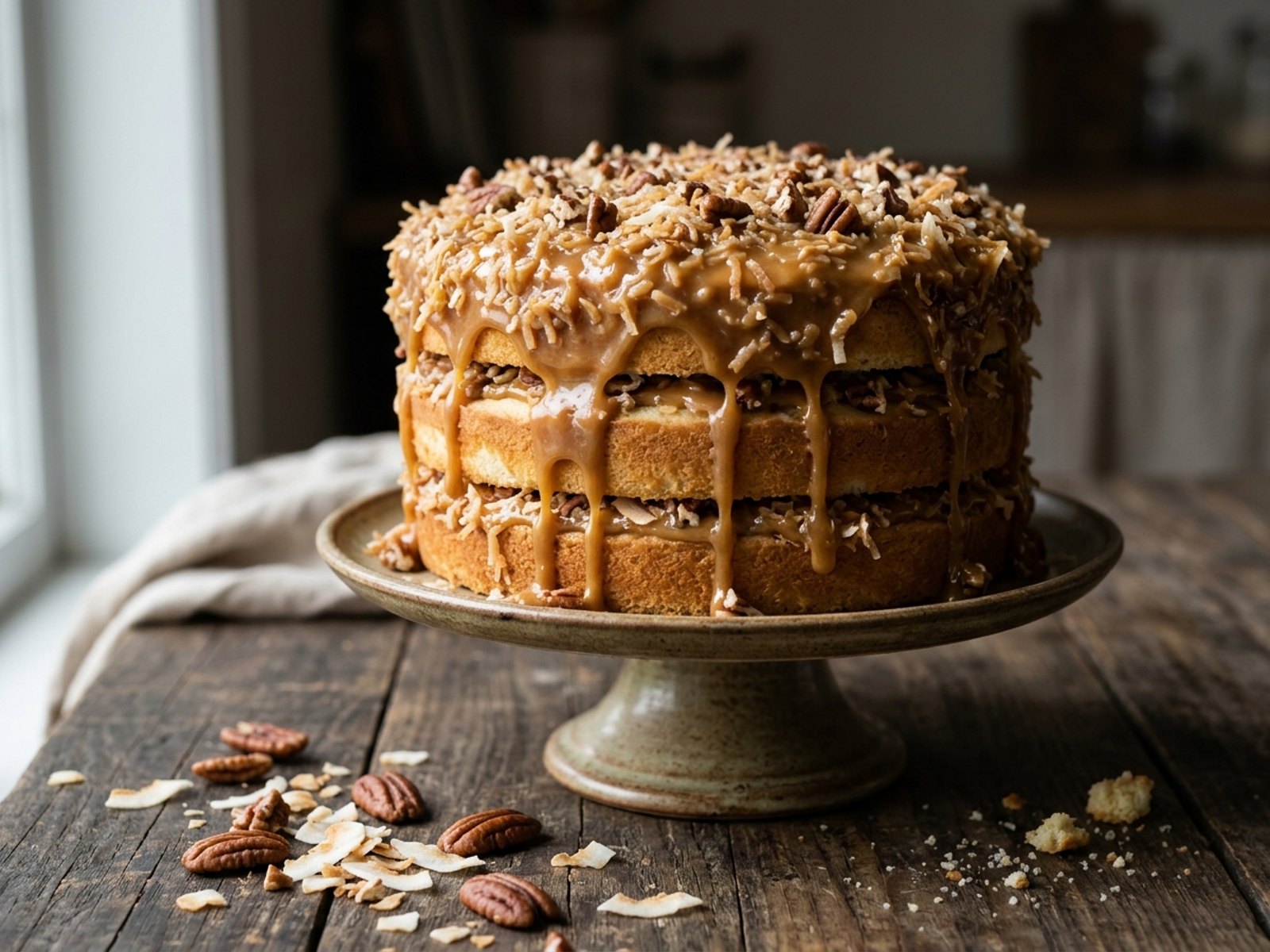
If you grew up thinking German chocolate cake meant dark chocolate layers, this white German chocolate cake is a nice surprise. The layers are pale, soft and vanilla-scented, stacked with the same gooey coconut pecan frosting you’d expect. It looks like something from a bakery case, but it starts with a white cake mix and a box of instant pudding, so it’s genuinely low-stress.
Once the weather cools and the oven’s back in regular rotation, I bake this white German chocolate cake a lot. It’s my pick when I need a dessert that feeds a crowd without asking for fancy decorating skills. The frosting is supposed to look thick and rustic, so a swoopy, imperfect finish is the goal here, not a flaw.
What makes white German chocolate cake different
Classic German chocolate cake isn’t German at all. It’s named for Samuel German, who developed a sweet baking chocolate for Baker’s Chocolate back in 1852, and the recipe went national after a Texas newspaper printed it in the 1950s. The German chocolate cake Wikipedia article has the whole story if you’re curious.
This version keeps the frosting and skips the chocolate layers. Swapping in a vanilla crumb does two things: it lets the caramel-y coconut pecan frosting be the loudest flavor in the room, and it makes a prettier slice. Pale cake, thick amber frosting, flecks of toasted pecan. When people ask me what a white German chocolate cake tastes like, I tell them it’s the best parts of a coconut candy bar in layer-cake form.
What’s in the cake layers
The shortcut is one box of white cake mix plus one box of instant vanilla pudding, and I’d argue it’s the smartest way to build a white German chocolate cake. The pudding adds starch and fat, so the crumb stays moist for days and bakes up sturdy enough to hold a heavy frosting without compressing.
A few notes on the rest of what goes in:
- Egg whites, not whole eggs. Yolks tint the crumb cream-colored. Four whites keep the layers genuinely white, and the yolks go straight into the frosting anyway, which is tidy.
- Sour cream. Full-fat, at room temperature. This is what makes the layers taste homemade instead of boxy.
- Almond extract. Optional, half a teaspoon. It gives the cake that bakery flavor people can never quite identify.
- Oil plus milk. Oil keeps the crumb soft even straight from the fridge, which matters because this cake gets stored cold.
How to tell the layers are done
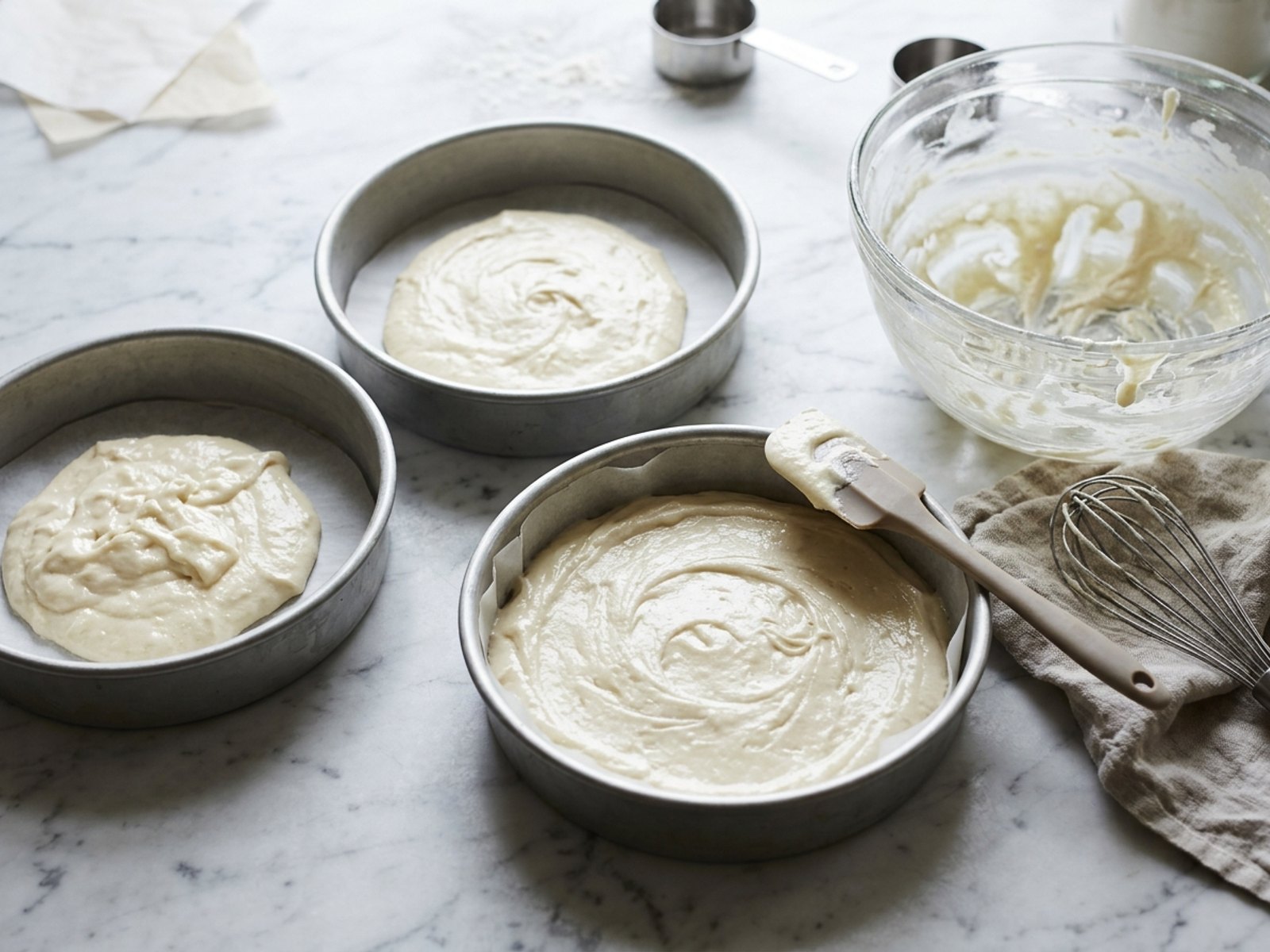
Divide the batter among three greased, parchment-lined 8-inch pans. It’ll be noticeably thicker than plain box-mix batter, which is correct. About two cups per pan gives you even layers without a kitchen scale.
Bake at 350°F and start checking at 22 minutes. The tops should spring back when you press them lightly, the edges pull just barely from the pan, and a toothpick comes out with a few moist crumbs clinging to it. Not wet batter, and not bone-dry either. Pull them at moist crumbs. These white German chocolate cake layers overbake fast, and the line between done and dry is maybe three minutes.
Cool in the pans for 10 minutes, then turn the layers out onto racks. White cake shows every smudge of grease and stuck crumb, so the parchment circles on the bottom are worth the extra sixty seconds.
The coconut pecan frosting
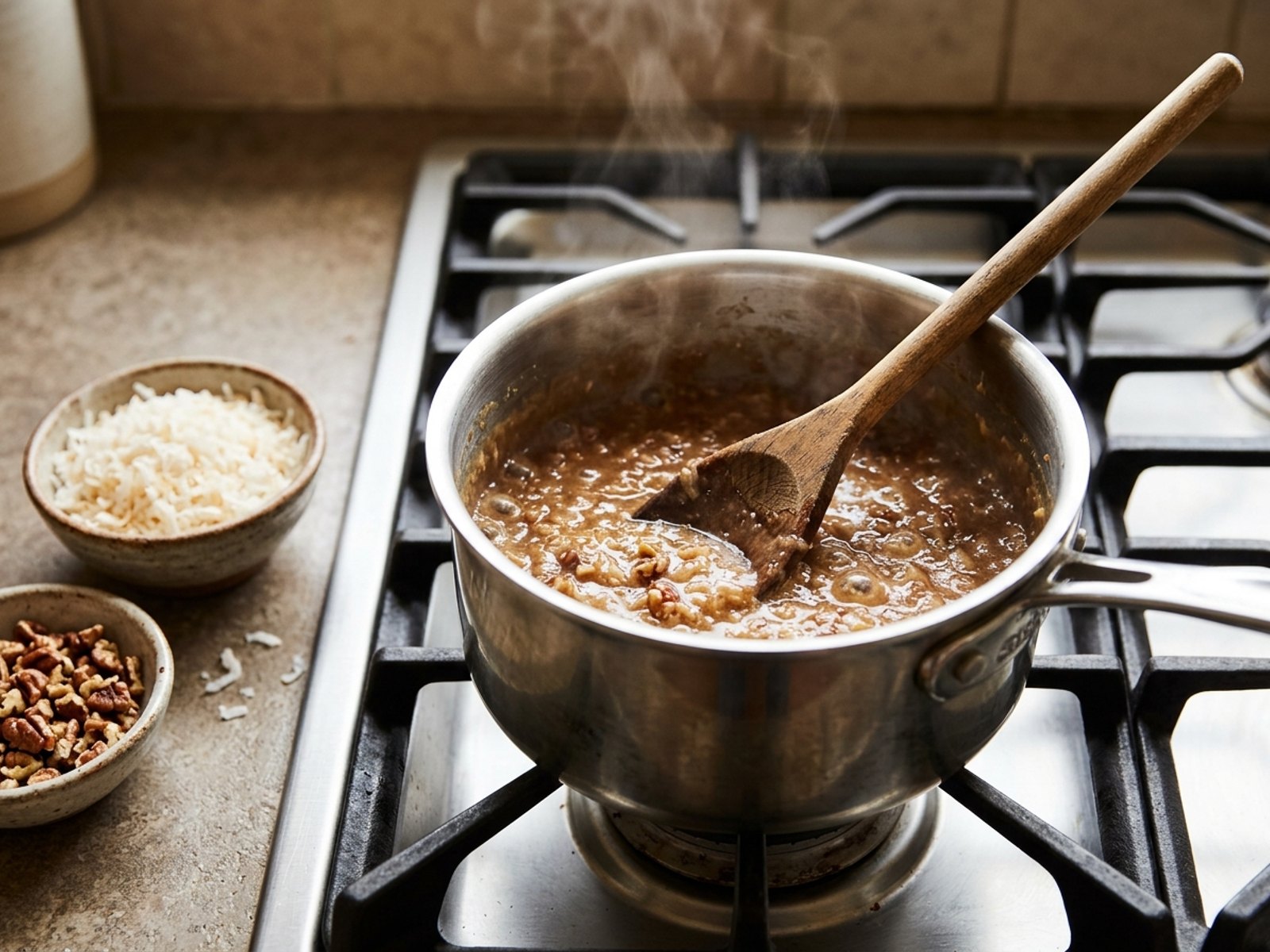
This is a cooked custard frosting, and it’s the part that makes people think you worked harder than you did. Evaporated milk, sugar, butter and egg yolks go into a saucepan together, and you stir over medium heat until it thickens into something between pudding and thin caramel. Then you fold in a pile of shredded coconut and toasted pecans.
The mistake that’s easy to make is pulling it off the heat too early. This cake lives or dies by this frosting, so here’s what I watch for:
- The mixture goes from foamy and thin to glossy and noticeably thicker.
- It coats the back of a spoon, and a finger swiped through it leaves a clean line.
- You see slow, lazy bubbles, and the color shifts to pale caramel.
- A thermometer reads around 170°F, which also takes the yolks into safe territory.
Plan on a full 10 to 12 minutes of constant stirring, scraping the corners of the pan as you go. Off the heat, stir in the vanilla, coconut and pecans. It’ll look too loose and you’ll doubt it. Don’t. It firms up dramatically as it cools, so let it sit 30 to 45 minutes, stirring every so often, until it’s spreadable. If coconut desserts are your thing generally, my Samoa Cheesecake lives in the same neighborhood.
Putting the cake together
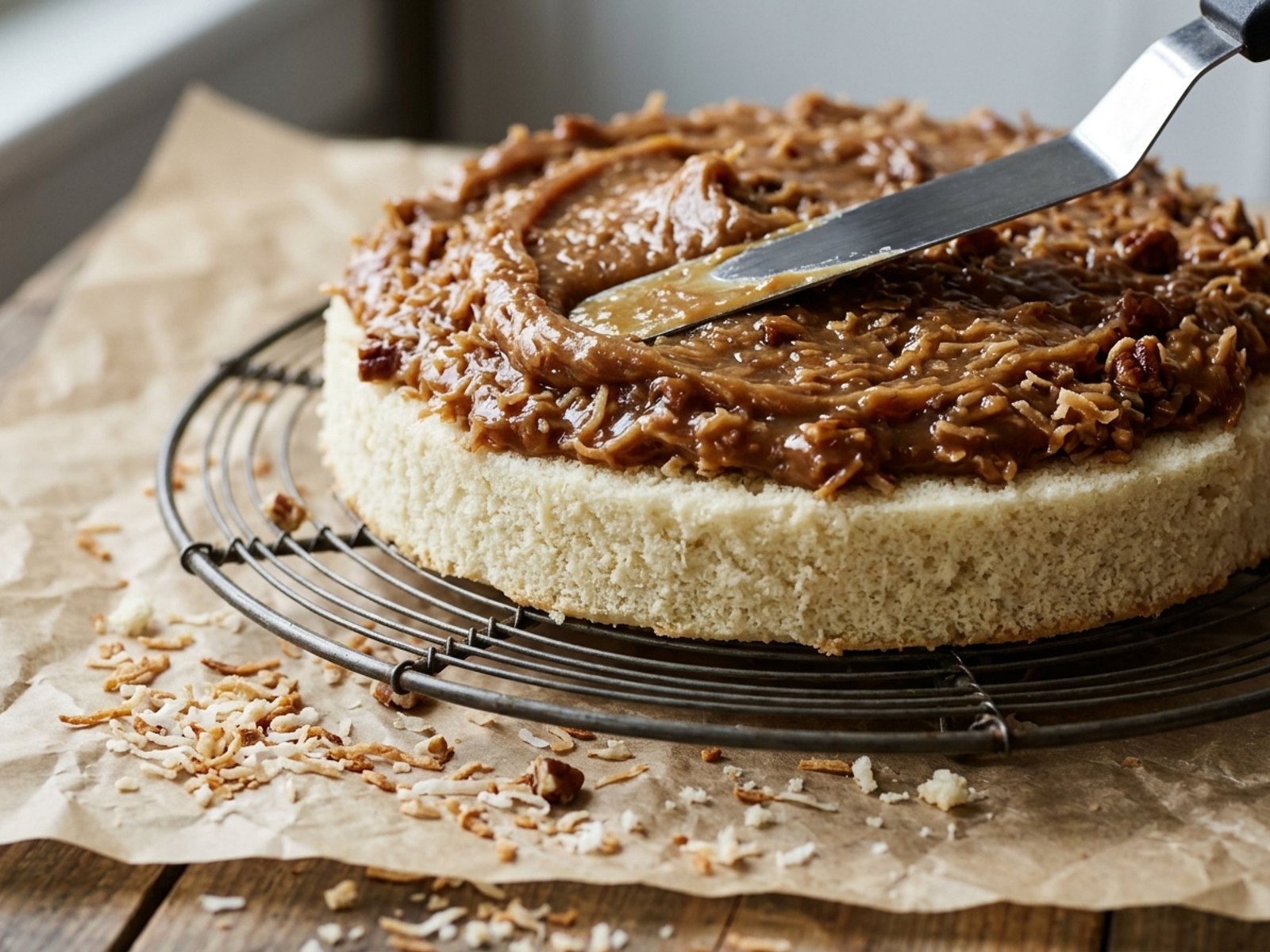
Completely cool layers only. Warm cake plus this frosting means sliding layers and a mess on your counter. Level the tops with a serrated knife if they domed, though this batter bakes up pretty flat for me.
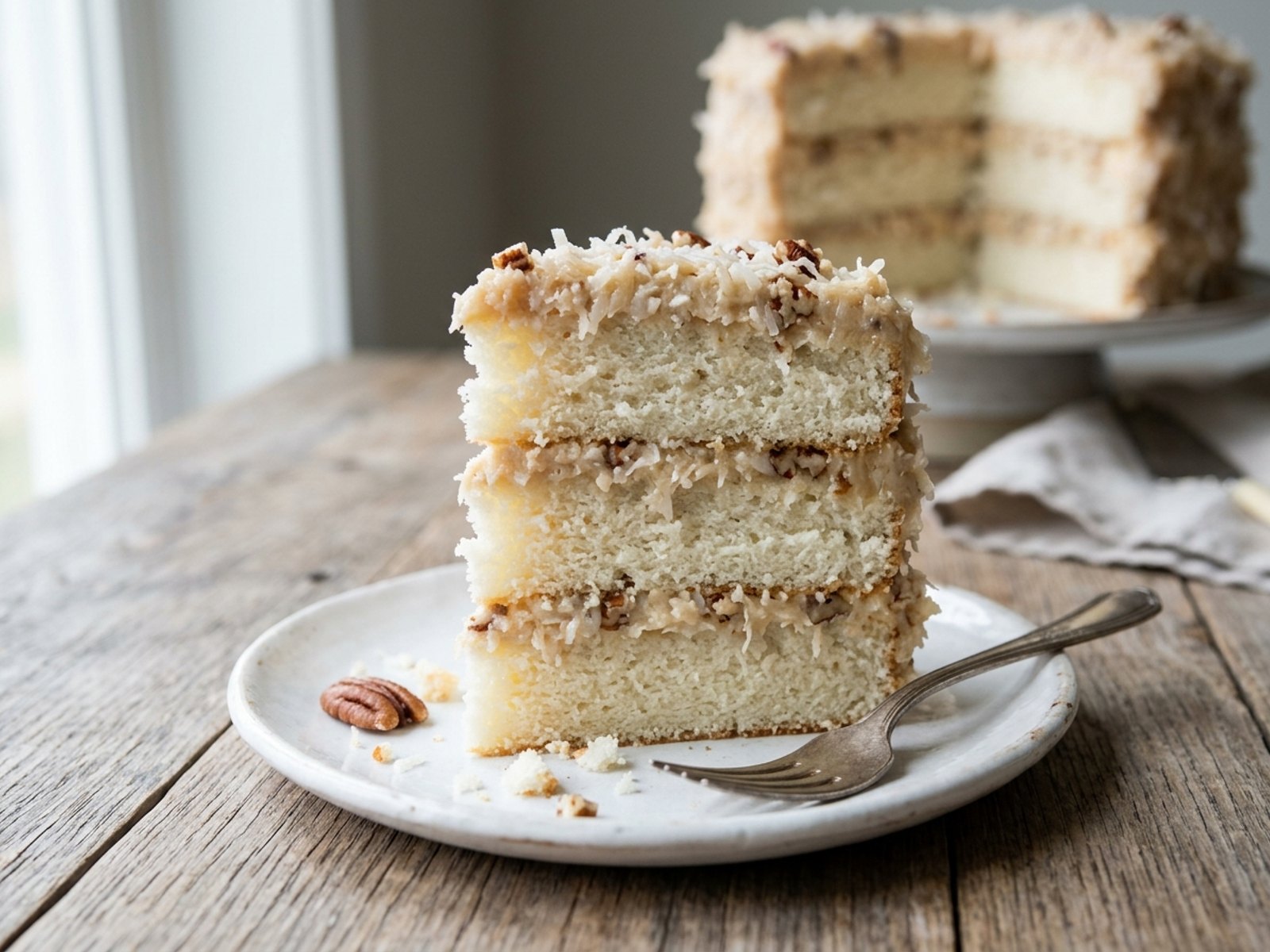
Set the first layer on your plate or stand, spread about three-quarters of a cup of frosting to the edges, then repeat with the second layer. Mound the rest on top and nudge it down the sides. The sides of a white German chocolate cake are traditionally left bare, and I love it that way: less work, and you can actually see the layers. If you’d rather cover them fully, this recipe makes enough frosting either way.
Finish with a handful of toasted coconut or a few pecan halves on top. A drizzle of melted chocolate is pretty too, if you find yourself missing the chocolate part of the name.
Storing white German chocolate cake
This cake is honestly better on day two, once the frosting settles into the crumb a little.
- Layers ahead: bake up to 2 days early, wrap tightly and refrigerate, or freeze up to 3 months and thaw overnight, still wrapped.
- Frosting ahead: keeps 3 days in the fridge. Bring it to room temperature and stir well to loosen before spreading.
- Assembled cake: the frosting is a cooked custard with eggs and milk, so refrigerate it. Covered, it keeps 4 to 5 days. The USDA’s cold food storage chart is what I check for anything made with cooked eggs.
- Serving from cold: let slices sit on the counter 20 to 30 minutes so the frosting softens back up. Cold frosting is stiff and loses that gooey quality.
Little twists that work
The nice thing about a white German chocolate cake is how flexible the layers are. A few changes I’ve actually liked, and one I’d skip:
- German chocolate cake mix instead of white gives a pale tan crumb, a nice middle ground if your family misses the original.
- Toast the coconut first. Ten minutes at 325°F deepens the flavor and looks gorgeous against the white cake.
- Cupcakes: fill liners two-thirds full, bake 18 to 20 minutes, and spoon the frosting on in thick, rustic dollops.
- What I’d skip: chocolate chips in the batter. They sink, and they streak the white layers gray.
Serve skinny slices with coffee and let the frosting carry the richness. For a bigger dessert table, Butterfinger Cake and Homemade Glazed Donuts both hold well at room temperature for hours. And if layer cakes are your weakness, the Nutter Butter Peanut Butter Layer Cake deserves a spot on your list.
White German chocolate cake is one of those recipes that looks like a project and isn’t. A box mix, a saucepan, a bowl. The hardest part is stirring the frosting, and even that only asks for ten minutes and a wooden spoon. Make it once and I suspect it’ll end up in your regular rotation, right next to the chocolate original.
White German Chocolate Cake with Coconut Pecan Frosting: the recipe
Prep 25 min · Cook 45 min · Total 70 min · Serves 12
Ingredients
Cake Layers
- 1 box (15.25 oz) white cake mix
- 1 box (3.4 oz) instant vanilla pudding mix
- 1 cup full-fat sour cream, at room temperature
- 1/2 cup vegetable oil
- 1/2 cup whole milk
- 4 large egg whites, at room temperature
- 1 teaspoon vanilla extract
- 1/2 teaspoon almond extract (optional)
Coconut Pecan Frosting
- 1 can (12 oz) evaporated milk
- 1 1/2 cups granulated sugar
- 3/4 cup unsalted butter (1 1/2 sticks)
- 4 large egg yolks, lightly beaten
- 1/4 teaspoon salt
- 1 teaspoon vanilla extract
- 2 cups sweetened shredded coconut
- 1 1/2 cups chopped pecans, toasted
Instructions
- Heat the oven to 350°F. Grease three 8-inch round cake pans, line the bottoms with parchment, and lightly flour the sides.
- In a large bowl, beat the cake mix, pudding mix, sour cream, oil, milk, egg whites, vanilla and almond extract on low for 30 seconds, then on medium for 2 minutes, until thick and smooth.
- Divide the batter evenly among the pans, about 2 cups each, and smooth the tops.
- Bake 22 to 27 minutes, until the tops spring back when pressed and a toothpick comes out with a few moist crumbs.
- Cool in the pans 10 minutes, then turn the layers out onto racks and cool completely.
- For the frosting, whisk the evaporated milk, sugar, butter, egg yolks and salt together in a medium saucepan over medium heat.
- Cook, stirring constantly and scraping the corners, 10 to 12 minutes, until thick, glossy and pale caramel; it should coat a spoon and register about 170°F.
- Remove from the heat and stir in the vanilla, coconut and toasted pecans.
- Let the frosting cool 30 to 45 minutes, stirring occasionally, until thick and spreadable.
- Set the first cake layer on a serving plate, spread about 3/4 cup frosting over it, and repeat with the second layer.
- Top with the third layer and mound the remaining frosting on top, letting it spill naturally down the sides.
- Rest the cake 30 minutes before slicing so the frosting sets.
Notes
- Use egg whites for the whitest layers; the yolks go into the frosting, so nothing gets wasted.
- Toast the pecans on a sheet pan at 350°F for 6 to 8 minutes, until they smell nutty.
- If the frosting seems thin right off the stove, give it the full cooling time; it thickens a lot as it sits.
- Swap the white cake mix for German chocolate cake mix for a light tan crumb closer to the classic.
- Store covered in the refrigerator for up to 5 days, and bring slices to room temperature before serving.
Nutrition per serving
Calories: 640 · Protein: 7g · Carbs: 84g · Fat: 34g · Fiber: 2g · Sugar: 60g · Sodium: 430mg